

You're Probably Thinking About Cognitive Dissonance All Wrong
The standard activist script doesn't account for what the psychological research says. Here's what does.

Billie Eilish has made waves recently. No, I’m not talking about how she accidentally eliminated Genevieve on Survivor, but her recent comments about how people can’t love animals and also eat meat. The reaction: a verifiable outcry, exactly on cue. Cognitive dissonance right in front of our eyes.
But here’s the thing, I think lots of animal advocates are thinking about cognitive dissonance all wrong. We tend to think of it as a frustrating mental barrier – something to shake our fists at—rather than an aspect of human psychology we need to think about and navigate critically. I get it! It is frustrating seeing people advocate for suffering, or even worse, lob bigoted comments at anyone who’s actually trying to make the world a better place. But that’s not actually going to end factory farming.
Here’s my deep dive into the psychology of cognitive dissonance, and how I think we can navigate it better. The next time a musical artist makes waves like this, we need to figure out how to stop being cast as the bad guy.
What is Cognitive Dissonance Anyway?
Cognitive dissonance is the mental discomfort you feel when you’re holding two beliefs — or a belief and a behavior — that don’t fit together, and the mental work you do to make them gel. Like how I can maintain an extremely sophisticated cinematic palette and an unabashed love of Mean Girls. Grool.
The term comes from social psychologist Leon Festinger, who was curious after seeing doomsday cults — when the world stubbornly didn’t end, why did the members double down on their faith instead of abandoning it? In his 1957 book A Theory of Cognitive Dissonance, he argued that we’re wired to reduce that internal friction, usually by taking the path of least resistance: tweaking a belief, dismissing inconvenient evidence, or quietly updating your doomsday theology so that Balazoor eats the world next year, not this year. The main takeaway is that behavior change is way harder than changing our mindset.
When it comes to meat reduction, the connection is obvious: people feel discomfort when they realize that farmed animals suffer as a direct result of their actions. The connection to meat-eating is so strong that it even has its own name: meat‐related cognitive dissonance (MRCD). As anyone who has ever seen the word “vegan” online knows, MRCD can be extremely powerful, even leading people to believe that a dietary group that makes up around 95% of the world is stigmatized itself.
How do people sort through their own MRCD? In general, through dissonance reduction, psychological or behavioral strategies to, well, reduce our dissonance. There are plenty of ways to reduce dissonance, so I plotted them all below.
How Omnivores Navigate Cognitive Dissonance:
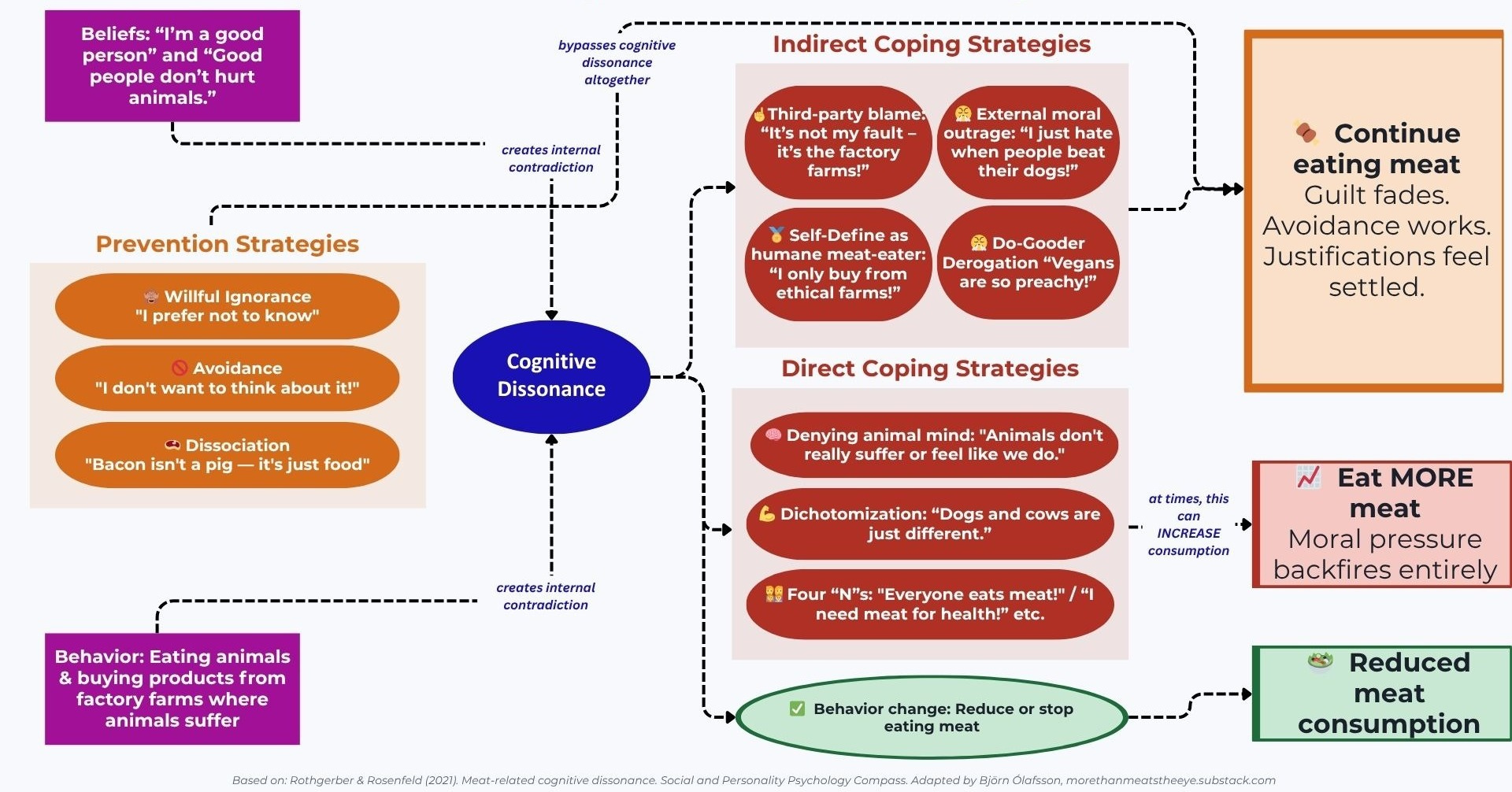
This is a big reason why getting people to eat less meat is so hard — it is far easier to change your cognitions, especially considering that most people in the world will affirm this for you, than to change your behavior. It’s especially tricky when some studies show that even reading about a vegetarian or vegan can trigger cognitive dissonance — no finger-wagging required. Not even a vegetarian protesting or anything, just like a dude who happens to be vegetarian.
It’s not just meat-eaters. A 2023 study showed that vegetarians and pescatarians showed notably high levels of dairy/egg-related dissociation — arguably because they’re the most motivated to disconnect products they still consume from the farming practices they otherwise oppose. Another study digs in more: pescatarians actually attributed lower sentience, intelligence, and moral concern to aquatic animals than even omnivores did. Same story with dairy and eggs: both vegetarians and pescatarians rated dairy cows as less sentient and morally worthy than beef cows, and layer hens lower than broiler chickens — even though it’s literally the same animal. Our defenses track what’s on our plates, not our principles.
This shows us that while we might like to think that the poster child of cognitive dissonance is the hard-core carnivore waving barbecue tongs around like he’s about to go into battle, that’s not what the research suggests. Everyone can rationalize their way out of changing; cognitive dissonance is slippier than it might seem.
Men and women experience cognitive dissonance differently — a 2018 experimental study found that when participants were exposed to information about the animal origins of their food, women experienced significantly more negative emotions and decreased attachment to meat, while men’s feelings barely budged. More telling: men’s attachment to meat actually increased when confronted with the meat-animal connection — a defensive doubling-down that will surprise no one who has ever argued about this at a dinner table. The underlying pattern makes psychological sense. Women tend to manage the meat paradox through dissociation — mentally separating the pork chop from the pig — which means that when that strategy is blocked by a visual reminder, they feel the discomfort more acutely. Men, meanwhile, tend to respond to the same challenge by digging in.
The standard activist move — point out the contradiction and let guilt take the wheel — is already a fairly blunt instrument. For many people, particularly men, the data suggest it can actually backfire.
How We Should Change Our Advocacy
I often find that vegan activists use cognitive dissonance more like gotcha journalists than therapists: springing out to point out hypocrisies instead of thinking critically about how to approach a complicated mental concept. I’m guilty of this myself! But I don’t think that’s helpful — we’re too focused on critiquing its existence after-the-fact instead of trying to navigate it correctly before it occurs. Here are three ways to approach it better:
First, think critically about the order of the conversation.
This is probably the most important thing: avoiding having these conversations after someone eats meat. In one study, participants were assigned to eat either cashews or beef jerky and then complete a series of tasks seemingly unrelated to the snack. One of those tasks turned out to be identifying the moral value of certain animals, including a cow. The people who ate beef jerky rated the cow as less deserving of moral worth than the people who munched on cashews. In other words, eating meat makes people value animals less, at least in the immediate aftermath of their meal.
Another study took it further. They had participants write about cows and sheep in front of either a bowl of apples or “an appetizingly presented delicatessen roast beef/lamb infused with rosemary and garlic.” The folks who rated the farmed animals in front of their meat were more likely to say those animals had limited mental capabilities than those who did it in front of a fruit basket.
So the data is clear on what to avoid — but the flip side is just as important: when should you have this conversation? The answer isn’t just “not after a meal.” I’d argued it’s after someone has already done something positive. If someone is halfway through Veganuary, has just called their representative about the Farm Bill (please do this), or tried out a new plant-based restaurant, they’re more likely to want to have this conversation. Action precedes openness.
Timing, though, is only half of it. The induced hypocrisy paradigm, developed from Festinger’s original theory and now backed by several decades of empirical research, flips the standard activist script. Instead of confronting someone with their contradiction, you ask them to voice a value they already hold, and then — privately, not publicly — invite them to notice where their behavior falls short. It’s been applied to condom use, recycling, discrimination, and blood donation with consistent effects. Start by asking what they value — do they like animals, do they care about sustainability? Then, privately, invite them to consider whether their actions line up. I know it sounds like therapy-speak, but lots of organizations already use this idea in their conversations and messaging!
The underlying logic — meet people where their values already are — has been tested directly in animal advocacy contexts. One study at a zoo found that a message reading “Do you consider animal welfare to be important?” above a veggie burger doubled its orders compared to a control, from 5% to 10%. I mean, that’s still pretty low for a place that claims to be all about loving animals, but I digress.
For animal advocates, the implication is counterintuitive but clear: the conversation that changes behavior probably starts with you asking someone what they believe about animals, not telling them what you think of their diet.
Second, validate and affirm the person’s agency and morality.
A landmark study across 89 countries during COVID-19 found that autonomy-supportive messaging (language that emphasizes choice and personal agency instead of obligation) reduced stubbornness toward social distancing compared with controlling or shame-based appeals. If you’ve ever heard someone say that vegans are “shoving things down my throat,” this probably feels familiar to you. The practical translation is simple: lead with options, not imperatives. “Here are some ways people are reducing their consumption” lands a bit better than “you need to stop eating meat.”
While you’re at it, you should probably uplift the person as well — according to self-affirmation theory, people respond far less defensively to threatening messages when they’ve first been reminded of who they are at their best. You may be saying “farmed animals are suffering” or “meat is murder,” but they might be hearing “you think I’m a bad person.” Try something more like “I know you’re trying to do the right thing here, I see it.1”
Third: when all else fails, change the ask.
There probably comes a point in certain advocacy conversations when you realize the other person isn’t changing their diet today, this year, or possibly ever. That doesn’t mean the conversation is wasted. Consider shifting the ask to something easier — voting for pro-environmental or pro-animal politicians, donating to animal welfare organizations or alternative protein companies, or supporting other meat-reduction policies, like plant-based defaults or meat taxes. This is arguably the better play regardless: the meat reduction movement is egregiously underfunded, and collective action through policy and funding may be more important in the long run.
The Bottom Line
The next time a pop star says something about animals and the internet catches fire, everyone who cares about this issue will face a choice: join the pile-on and get the dopamine hit of being publicly right (again, I’m calling myself out here too), or actually try to use the moment. Cognitive dissonance is a feature of the human brain, not a bug — it’s not going anywhere, but it is navigable. So instead of catching someone mid-burger and hoping guilt does the rest, we should try asking before telling, meeting people where their values already are, and knowing when to change the ask entirely.
Billie Eilish isn’t the first person to place the meat paradox firmly into the news cycle, and she won’t be the last. The question is whether we get any better at this.
Thank you!
Thank you for reading! I always make these resources available for free, but please consider becoming a paid subscriber if you find my work valuable.
Side note: this may not work online because our anti-earnest digital culture probably makes this one impossible. Like, I can’t even imagine reading these sentences in comments without thinking I’m being condescended to.
Great article, and highly needed.
Maybe something to add/clarify further is that, while vegans lament the cognitive dissonance, it's not the CD in itself that's the problem, but the chosen CD-reducing strategy is (mostly rationalizing/willful ignorance).
(I think this also starts with people realizing what the CD actually is, namely an internal friction. It's not synonymous with hypocrisy or anything. I constantly see it used the wrong way. )
Thanks for this article. It really provides an scientific angle to understand these contradictory claims from “animal lovers” who actually love none.